How these records are tuned
444 Hz Tuning
Every Return to Faith song is pitched to A = 444 Hz rather than the usual 440. Here is what that means, what it does to the sound, and what is documented fact versus what is a claim.
The choice
Every song on this site is pitched to 444 Hz
Almost all recorded music is anchored to A above middle C at 440 Hz — the modern standard, and the default in every instrument, sampler and recording program. A reference pitch does not add or remove notes; it slides the whole scale up or down together. Setting it to 444 Hz raises everything by about sixteen hundredths of a semitone.
That is a small move, and deliberately so. It is enough to change the character of a record — the top end opens up, the voice sits a little further forward — without sounding out of tune to anyone singing along. Every release in the catalogue is tracked at that reference and checked afterwards, so the whole shelf of songs is at the same pitch and plays together.
Brighter without sounding wrong
At 444 Hz everything sits about 16 cents above the modern standard — close enough that listeners hear lift and presence rather than a mistuned record.
Lead vocals sit forward
That small increase in perceived brightness tends to help a lead vocal cut through a dense mix without extra top-end EQ.
528 Hz inside the harmony
C is one of the most common tonal centres in worship music. At 444 Hz every C in the recording genuinely sounds at 528 Hz.
One decision, held all the way through
The reference is set once at the start of a session and kept across every take, sample and stem, so nothing clashes later.
Reference A 444 Hz
A4
444.00 Hz
+3 cents
The arithmetic
Why 444 and not 445: it puts C on 528
The reason this particular reference gets chosen is not mystical. It is a short sum anyone can check.
In equal temperament every note is the reference multiplied by 2n/12. C is three semitones above A, so C5 = 444 × 23/12 = 528.01 Hz — within a hundredth of a cent of 528. At the standard 440 Hz the same note is 523.25 Hz, about 16 cents flat of it. Retune a song to 444 Hz and every C in the recording genuinely sounds at 528 Hz.
528 Hz matters because it is the best known of the Solfeggio frequencies — the MI tone, taken from the hymn line MI-ra gestorum, “miracle of deeds.” It is commonly called the miracle frequency or the love frequency, and is traditionally associated with renewal, wholeness and the repair of what has been broken.
Some writers have gone further and explored whether 528 Hz affects the structure of water or supports DNA repair. Those ideas are speculative and are not established in peer-reviewed research. What can be said plainly is that 528 Hz is a real acoustic frequency, that many listeners experience music containing it as calmer and more open, and that at 444 Hz it is not an occasional reference tone — because C is such a common tonal centre in worship music, it recurs constantly through the harmony.
For a believer the appeal is often simpler than any of the claims: it is a tone named for the works of God, and choosing a tuning that lets it sound naturally inside ordinary songs is a way of being intentional about what is being offered.
| Reference | C5 lands on | Solfeggio alignment |
|---|---|---|
| 440 Hz (standard) | 523.25 Hz | No Solfeggio tone lands on a scale degree. C5 misses 528 Hz by about 16 cents. |
| 432 Hz | 513.74 Hz | No Solfeggio alignment, but unusually tidy numbers: in Pythagorean tuning A = 432 puts C at exactly 256 Hz. |
| 444 Hz | 528.01 Hz | C5 lands on 528 Hz within a hundredth of a cent, and G4 (395.56 Hz) sits about 2 cents from 396 Hz. |
A cent is one hundredth of a semitone. Around five cents is the smallest difference most trained listeners reliably hear on a sustained tone.
Context
The Solfeggio frequencies, and where they come from
An eighth-century hymn, a twentieth-century set of numbers, and the line between the two.
The six core tones are 396, 417, 528, 639, 741 and 852 Hz, usually extended with 174, 285 and 963. Their names — ut, re, mi, fa, sol, la — are documented music history. They come from Ut queant laxis, the Latin hymn to John the Baptist whose successive lines each begin one scale degree higher. Guido of Arezzo used it in the eleventh century to teach sight-singing, and it is the direct ancestor of the do-re-mi still taught today.
The hertz values, though, are modern. They were put forward in the late twentieth century — Joseph Puleo and David Hulse are the names usually credited — by applying a numerical digit-reduction scheme to passages in the Book of Numbers and mapping the results onto the hymn’s syllables. Medieval musicians had no way to measure a frequency in hertz and no concept of one; the assignment is an interpretation laid over the old hymn, not something recovered from it.
The effects attributed to each tone are traditional associations rather than findings from controlled research. They are listed here so you know what people mean when they reference them. Held honestly — as devotional practice, as a compositional constraint, as a set of drones to write over — they are genuinely useful.
| Frequency | Syllable | Traditionally associated with |
|---|---|---|
| 174 Hz | Extended tone | Relief of tension, and a sense of steadiness. |
| 285 Hz | Extended tone | Restoration and repair. |
| 396 Hz | UT | Release from fear and guilt. |
| 417 Hz | RE | Breaking unhelpful patterns; beginning change. |
| 528 Hz | MI — the “miracle tone” | Renewal, wholeness, and the repair of what has been broken. |
| 639 Hz | FA | Reconciliation, relationship and communication. |
| 741 Hz | SOL | Cleansing, clarity and honest expression. |
| 852 Hz | LA | Discernment, and returning attention to what is above. |
| 963 Hz | Extended tone | Stillness, and openness to the divine. |
How this page is written: the alignment of C5 with 528 Hz at 444 Hz tuning is a verifiable mathematical fact. The wellbeing and healing effects attributed to 528 Hz and to the other Solfeggio tones are traditional claims that have not been demonstrated in controlled research, and nothing here is medical advice.
Reference bench
Hear the difference
Sine tones straight from your browser. Headphones give the truest read.
At this reference, C5 sits at 528.01 Hz in equal temperament.
The octave at A = 444
Solfeggio reference tones
Tap any tile to sustain the tone; tap again to stop. Start at a low volume — a sustained sine is louder than it looks.
The app
Convert any of your own songs to 444 Hz, free
The tool these records are tuned and checked with is a free browser app from Return to Faith Ministries.
444 Hz Tuner
444hz.app
Drop a song in, and it comes back at 444 Hz — same tempo, same length.
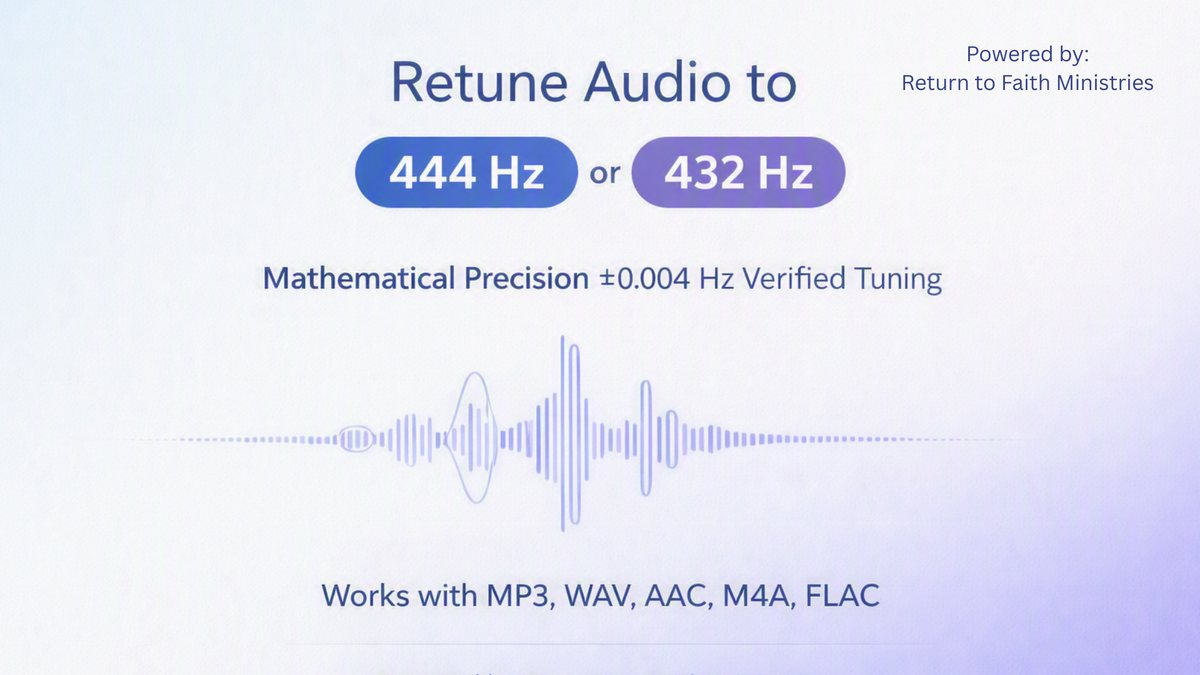
It reads MP3, WAV, AAC, M4A and FLAC, measures where the recording’s A4 actually sits, and retunes the whole file to the reference you choose — 444 Hz, 432 Hz, or anywhere between 400 and 480 — without changing the tempo. There is also a 528 Hz checker that reports where a track’s C5 truly lands, in hertz and in cents, so a file labelled 528 can be verified instead of trusted.
It is free, needs no account, and runs entirely in the browser: the audio never leaves your device.
For music creators
Some more apps to help with your music workflow
Vertical edits for Shorts, and compression for audio, video and images — all free, all in the browser.
See the music apps